Blog Post
-
What Is Paint Correction? (And What It Can't Fix)
Paint correction removes swirls and light scratches, but not rock chips or deep damage. Learn what it fixes, what it can't, and what it costs in Alabama.
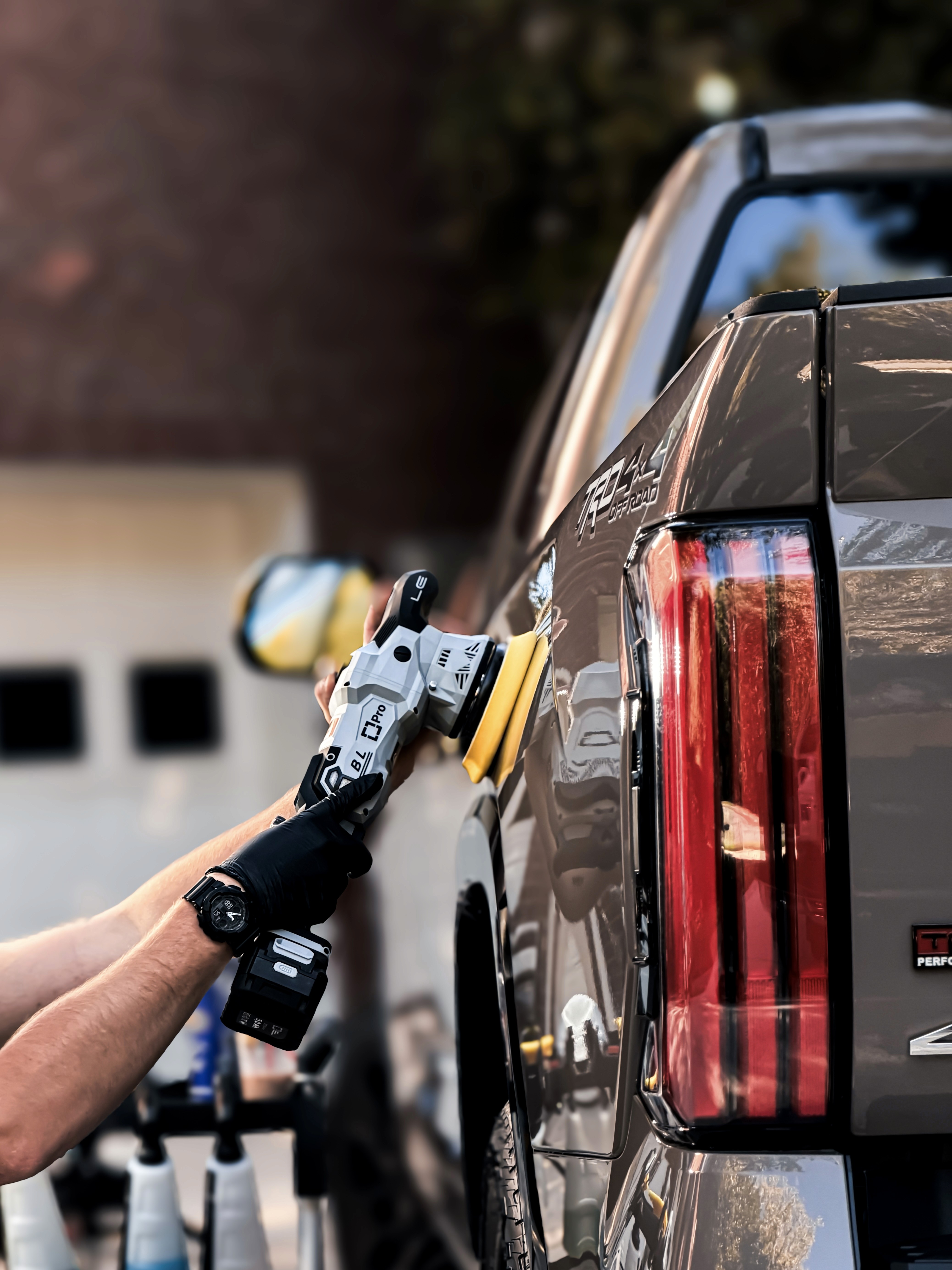
The short answer: Paint correction is the process of polishing your vehicle's clear coat to remove swirl marks, light scratches, haze, and oxidation. It levels the surface so light reflects evenly again. It does not fill, repair, or replace paint. Rock chips, deep scratches, dents, and failing clear coat are outside what polishing can fix, and any shop that implies otherwise is selling you a result paint can't deliver.
Knowing the difference matters before you spend money on correction, and it matters even more before you put a ceramic coating over it.
What Paint Correction Actually Is
Your paint is a stack of layers: primer, color coat, and a transparent clear coat on top. The clear coat is what you see shine, and it's also what takes the abuse: automatic car washes, dirty wash mitts, dry wiping, road grime, and years of Alabama sun.
Those small abrasions leave microscopic scratches in the clear coat. Under direct light they show up as swirl marks, spiderweb patterns, and a dull, hazy finish that no wash will remove, because the damage isn't dirt sitting on the paint. It's a change in the shape of the surface.
Paint correction removes that damage by polishing away a very thin amount of clear coat until the scratch edges are level with the surrounding surface. The scratch isn't filled. It's removed, because the material around it has been taken down to meet it.
That last point is the one that defines the whole service.
Why Clear Coat Is a Finite Resource
Every pass with a polishing pad removes paint. Permanently. Clear coat is measured in microns, and a vehicle has only so much of it to work with. Once it's gone, no product brings it back.
This is why responsible correction is a measured decision, not a bigger-is-better one. The goal isn't to remove as much as possible. It's to remove the least amount necessary to get the best result the paint can safely give.
It's also why we inspect before we quote. Paint thickness, prior polishing, and the condition of each panel all change what's safe and what's realistic. We don't promise a percentage of defects removed, because a promise like that ignores what's actually on your paint.
What Paint Correction Can Fix
Swirl marks and spiderwebbing from washing and drying
Light to moderate scratches that haven't gone through the clear coat
Haze and dullness from years of surface wear
Oxidation in its early stages, where the clear coat has dulled but is still intact
Some water spot etching that hasn't cut deeply into the surface
Wash and wipe marring left by previous poor technique
What Paint Correction Cannot Fix
This is the list most shops skip. We think it's the most useful part of the article.
Rock chips. A rock chip is a crater. Material is missing, often down to the primer or bare metal. Polishing can't put paint back where it no longer exists. Chips are repaired with touch-up paint or a proper paint repair, not correction. And to be direct: a ceramic coating doesn't stop rock chips either. It's a chemical protection layer, not armor. If chip protection is your goal, that's a conversation about paint protection film.
Deep scratches. If a scratch catches your fingernail, it has likely gone through the clear coat and into the color coat. Polishing can soften the edges and make it less visible, but it can't remove a scratch that's deeper than the clear coat you'd have to take off to reach the bottom of it.
Failing or peeling clear coat. Clear coat that's flaking, cracking, or turning cloudy in patches has lost its bond to the paint underneath. Polishing a failing surface can make it worse. The fix is refinishing the panel, not correction.
Dents and dings. Correction works on the surface of the paint. It does nothing to the shape of the metal underneath. Dents need paintless dent repair or bodywork.
Color coat damage. Fading, discoloration, or damage that has reached beneath the clear coat is no longer a clear coat problem. Polishing can't restore it.
Previously repainted panels with problems. Respray work can have uneven thickness or soft paint. Panels like this need careful inspection before anyone puts a machine on them.
A Quick Test You Can Do at Home
Run your fingernail gently across a scratch. If your nail doesn't catch, the scratch is likely shallow and a good candidate for correction. If your nail catches, the scratch is likely deeper than the clear coat, and correction will improve it but not erase it.
It isn't a substitute for an inspection, but it helps set expectations.
Single-Stage vs. Multi-Stage Correction
Not every vehicle needs the same amount of work.
Single-stage correction uses one polishing step to remove light swirling and haze and bring out gloss. For a newer vehicle with light wear, it often delivers a dramatic improvement.
Multi-stage correction adds a heavier cutting step before the refining polish. It's used when paint has more defects to work through, such as heavier swirling, more pronounced scratching, or more age on the finish. It takes more time and removes more material, which is why it's a deliberate decision and not a default.
Which one your vehicle needs depends on its condition, not on the package you'd like to buy. We tell you what we see.
Why Correction Comes Before Ceramic Coating
A ceramic coating bonds to the surface beneath it. It doesn't hide imperfections. It locks them in, under a hard layer that's far harder to polish than bare clear coat.
That's why correction isn't an optional extra in a proper coating process. It's the foundation. The coating can only be as good as the surface it's applied to.
At GHOSTPHORM, preparation is the product. Every package includes decontamination, correction, and a ceramic primer polish before the coating is applied. PHORM BASE, PRO, and ULTRA all include single-stage correction, and PHORM ULTRA includes two-stage correction for vehicles that need more.
What Does Standalone Paint Correction Cost?
If you want correction on its own, without a coating, pricing is quoted after inspection, typically between $500 and $2,000. The range is wide because the work is. A newer vehicle with light swirling and a larger vehicle with years of wear are not the same job.
Be cautious of flat, instant quotes for correction. Nobody can accurately price paint they haven't looked at.
How to Tell if a Shop Is Being Honest About Correction
Do they inspect your paint before quoting? They should, ideally under proper lighting.
Do they measure paint thickness? Reading it before correcting is how you avoid removing more than the paint can spare.
Do they tell you what they can't fix? A shop that never mentions limits is selling an outcome they can't guarantee.
Do they promise "100% defect removal"? Treat that as a warning. It's rarely true, and it's rarely safe.
Do they explain what stage of correction they recommend and why?
Frequently Asked Questions
Will paint correction remove rock chips?
No. A rock chip is missing paint, and polishing removes material, it doesn't add it. Chips are repaired with touch-up paint or professional paint repair. Correction can improve the surrounding paint, but it won't fill the chip.
Can paint correction remove all scratches?
No. It can remove scratches that sit within the clear coat. Scratches that have gone through the clear coat can often be reduced but not fully removed.
Does paint correction damage your paint?
Because it removes a small amount of clear coat, it should be done with care and only as much as necessary. Done properly, with inspection and measured passes, it's a controlled process. Done aggressively or repeatedly, it can thin the paint too far.
How long does paint correction last?
Correction removes the defects that are there, but it doesn't prevent new ones. How long the result lasts depends on how the vehicle is washed and cared for afterward. A ceramic coating helps protect the corrected surface, and proper hand washing keeps new swirls from forming.
Is paint correction worth it before a ceramic coating?
Yes. Correcting first means the coating locks in a refined surface instead of sealing in swirls and haze. It's the difference between protecting a finish and permanently preserving its flaws.
How do I know what my paint needs?
An inspection. We look at the paint panel by panel, tell you what's correctable and what isn't, and quote from there.
See What Your Paint Actually Needs
We come to you anywhere in Hoover, Birmingham, and across Jefferson and Shelby Counties. We inspect first, tell you the truth about what correction can and can't do, and quote from what we find.