Blog Post
-
How Polishing Really Works: Compounds, Abrasives and Why Traditional "Compound and Buff" Falls Short
Polishing levels clear coat, it doesn't fill scratches. Learn how compounds and abrasives work and why traditional buffing falls short. Birmingham, AL.
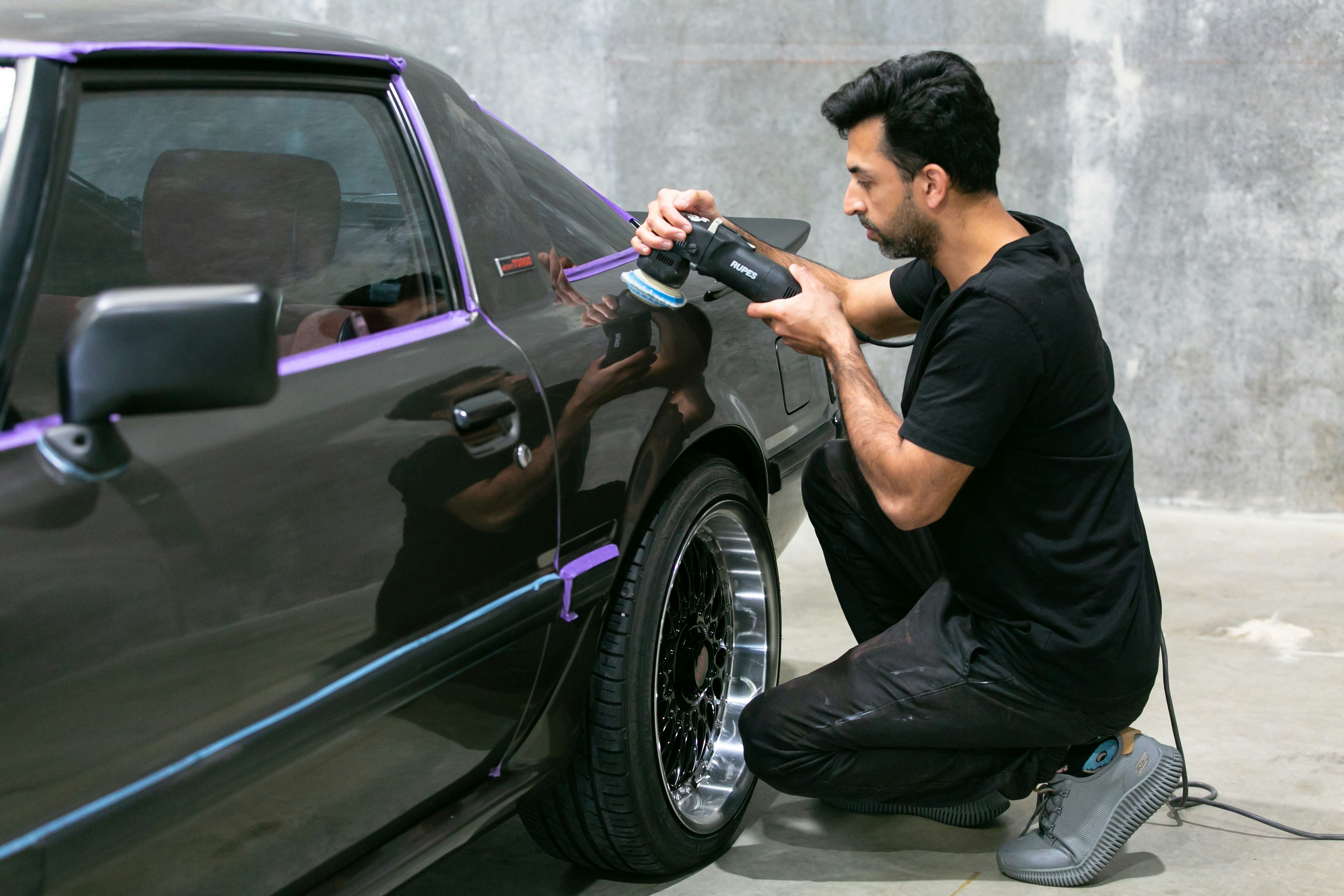
The short answer: Polishing doesn't "fill" scratches or "rub them out." It removes a microscopic layer of clear coat, using abrasives, until the surface is level with the bottom of the defect. Everything about doing it well comes down to controlling how much is removed, and where it stops. Traditional detailing treats polishing as a matter of feel: a heavy compound, a fast machine, and a glaze or wax to cover whatever is left. Our approach treats it as a measured process: the right abrasive for your paint, tested first, with the least amount of clear coat removed to get the result. This guide explains the science, and why the difference matters on a luxury vehicle.
What a Scratch Actually Is
Paint damage isn't on the surface. It's a groove cut into it. A swirl mark, a wash scratch or a light scuff is a tiny valley in the clear coat. Light hits the edges of that valley and scatters, which is why swirls glow under a single bright source like the sun, and why they look like a spider web.
There are only two ways to make a valley disappear:
Fill it. Pack something into it so the surface looks smooth. This is temporary.
Level it. Remove the surrounding surface until it's as low as the bottom of the valley. This is permanent.
True paint correction is the second one. It's the only method that removes the defect instead of hiding it.
How an Abrasive Does the Work
A polish or compound contains abrasive particles suspended in a liquid carrier. When a pad moves the product across the paint, those particles cut tiny scratches of their own, much finer than the original damage. Each pass replaces deeper scratches with shallower ones, until they're too small for the eye to see. The result is a smooth, uniform, reflective surface.
Three ideas explain nearly everything:
Cut. How quickly an abrasive removes material. High cut removes more, faster, and leaves finer marks of its own that need refining.
Finish. How smooth the surface is left. Finer abrasives remove less and leave a cleaner, clearer surface.
Heat and pressure. Abrasion generates heat. Too much heat, speed or pressure in one area removes clear coat faster than expected.
A compound has more cut. A polish has more finish. A finishing polish has the least cut and the most clarity.
Diminishing and Non-Diminishing Abrasives
Modern polishing products fall into two broad categories:
Diminishing abrasives break down as they're worked. They start with a more aggressive cut and refine to a finer finish as the particles shrink. They're forgiving and typically leave a cleaner finish, but they need proper working time and the right amount of product.
Non-diminishing abrasives keep a consistent size throughout. They cut the same way from the first second to the last. They can be efficient and predictable, but they need the right pad and technique to avoid leaving marks of their own.
Neither is better in all cases. The right choice depends on the paint, the defect and the stage of the work. A professional chooses based on a test, not habit.
Pads, Machines and Heat
The abrasive is only part of it. The pad and the machine change the result:
Pads. Foam pads range from firm cutting pads to soft finishing pads. Microfiber and wool pads cut more aggressively. A pad's firmness, structure and condition change how the product works.
Machines. A rotary polisher spins on a single axis. It cuts fast and builds heat quickly, and in untrained hands it can burn through paint or leave swirl-like "holograms" of its own. A dual-action (random orbital) polisher moves in a way that spreads heat and friction, which makes it safer on thin or high-value paint.
Pressure, speed and time. These decide how much clear coat leaves the panel and how evenly.
Traditional detailing often relies on a rotary and heavy product, trusted to the operator's feel. That can work in expert hands, and it leaves little margin on factory paint, edges, body lines and softer finishes.
The Part Most Detailing Gets Wrong: Fillers and Glazes
Many polishes, glazes and "polish and wax" products contain oils and fillers. They work by flowing into the scratches and leveling the light, which makes the finish look flawless. It looks great on the day, and it often disappears in a few washes, because the oils wash out and the scratches come back.
This is the practice behind the "it looked perfect when I picked it up" complaint. A finish that was masked, not corrected, can't survive the first months of washing, and a coating placed over a filled surface can lock in oils and residue that interfere with bonding.
Our approach is different. Correction means the defects are removed, not covered, and the surface is cleaned of oils and residue before anything is applied. What you see after polishing is what's really on the paint.
Clear Coat Is Finite, and Every Pass Takes Some
Polishing removes a small amount of clear coat on every pass. It's thin, typically measured in microns, and it carries the paint's UV protection and durability. It can't be put back. That's why polishing isn't a free step, and why the answer to "how much should be removed?" is always "as little as possible to get the result."
Paint also varies. Factory paint hardness differs by manufacturer, model and even panel, and repainted areas can behave differently from original paint. Some paints are soft and mark easily, and some are hard and resist correction. A product and pad combination that works beautifully on one car can be too aggressive or too weak on another.
How a Measured Correction Works
Here's how a professional approaches it, and how we do:
Decontaminate first. Bonded contaminants dragged across paint by a pad cause fresh scratches. See our guide to paint decontamination.
Inspect under proper light. Defects hide in diffuse light. See them first, then fix them.
Read the paint. Measure thickness, so the plan fits what the paint can safely give.
Test spot. Start with the least aggressive combination of product and pad that could work on a small area. Check the result under light. Step up only if it's needed.
Work in sections, with controlled pressure, speed and time, and wipe the residue between passes.
Refine. A finishing step restores the clarity and removes any marks left by the cutting step.
Remove oils and residue, so the surface is clean and the true result is visible.
Prime and coat. A ceramic primer polish prepares a uniform surface, then the coating goes on.
What "Single-Stage" and "Two-Stage" Mean
In general, a single-stage correction uses one machine-polishing step, chosen to remove as much defect as the paint can safely give while leaving a clear, refined finish. A two-stage correction uses a cutting step followed by a finishing step, which removes more defects and refines the surface further. Dark paint, heavier swirling and higher expectations usually call for two stages.
That's how our packages are built. PHORM BASE and PRO include single-stage correction. PHORM ULTRA includes two-stage correction. More correction isn't always better, because it removes more clear coat. It's about the right amount for the paint.
Traditional Detailing vs Our Approach
Traditional "compound and buff" | The GHOSTPHORM system | |
|---|---|---|
Starting point | Wash and start polishing | Full decontamination first |
How the plan is set | By feel and habit | By testing a small area and reading the paint |
Product choice | One compound and pad for the whole car | Matched to the paint, tested before use |
Tool and heat control | Often fast, heavy and operator-dependent | Controlled pressure, speed and time |
Result | Often looks flawless until the first washes, if fillers were used | Defects removed, not masked |
Clear coat | Removed by feel | Removed only as needed |
After polishing | Wax or glaze applied | Oils and residue removed, ceramic primer polish, then coating |
Questions Worth Asking Any Detailer About Polishing
Do you remove scratches or fill them? A clear answer means they know the difference.
How do you decide what product and pad to use? The right answer includes a test spot.
Do you measure clear coat thickness? On a luxury car, it should be a yes.
Will you use a glaze or filler? If so, how long will the result last?
What do you do with the surface before the coating?
How much will you remove, and why?
Frequently Asked Questions
Does polishing remove scratches or fill them?
True polishing removes them by leveling the clear coat. Some products fill them temporarily with oils and fillers, which wash out over time.
What's the difference between a compound and a polish?
A compound has more cut and removes more material. A polish is finer and refines the surface. A finishing polish is the finest.
Can you polish too much?
Yes. Each pass removes clear coat that can't be replaced. Over-polishing thins the layer that carries UV protection and durability.
Is a rotary polisher bad?
Not inherently, but it builds heat fast and leaves little margin for error on thin or high-value paint. A dual-action polisher is often safer.
Can all scratches be polished out?
No. Scratches that go through the clear coat or into the color layer can't be fully removed by polishing.
How long does a polish last?
Corrected paint stays corrected until new swirls or scratches are added by washing, drying and contact. Filled or glazed finishes can fade within weeks.
Do I need paint correction before a ceramic coating?
Yes, if you want the best result. A coating seals in whatever is on the paint, including swirls and haze.
Is paint correction included in your packages?
Yes. Every package includes decontamination, paint correction and a ceramic primer polish before the coating goes on. BASE and PRO include single-stage correction and ULTRA includes two-stage.
Do you serve Birmingham, Hoover and Mountain Brook?
Yes. We come to your home or office across Birmingham, Hoover, Mountain Brook, Vestavia Hills, and Jefferson and Shelby Counties.
Get the Correction Done Right
Choose your package, pick a date, and we'll handle decontamination, correction, primer and coating in one visit, at your home.